
WHEELTOP EDS TX vs OX 2.0: Which Wireless Derailleur Should You Buy?
TX or OX 2.0 — both are wireless, both are affordable, but they're built for completely different bikes. Here's how to pick the right one.
The Core Question: Road or Dirt?

If you've been trying to figure out the WHEELTOP EDS TX vs OX 2.0 difference, you're probably staring at two product pages that look almost identical and wondering what actually separates them. Fair question. On the surface they share the same wireless protocol, the same magnetic charging port, and the same companion app. But under the cage — literally — they're designed for completely different jobs. The TX is a road and gravel derailleur. The OX 2.0 is built for mountain bikes. Get that backwards and you're going to have a bad time.
Cage Length and Cassette Capacity
This is where the two derailleurs genuinely diverge. The EDS TX uses a shorter cage, optimized for road and gravel cassettes up to 36T. It's compact, low-slung, and handles the kind of close-ratio cassettes you'd run on a road bike or a lightweight gravel rig without drama. The EDS OX 2.0 ships in three cage lengths — 58mm short (10-32T), 75mm medium (10-42T), and 93mm long (10-52T) — so on the long cage it scales up to the kind of range you actually need when you're grinding up technical singletrack or loaded bikepacking trails. That's not something the TX cage could manage mechanically.
Why Cage Length Matters More Than People Think
A short cage derailleur physically cannot take up the chain slack required by a wide-range cassette. It's not a software limitation — it's geometry. If you force a short-cage derailleur onto a 46T cassette setup, you risk chain slap, dropped chains, or worse, a bent derailleur hanger on a technical descent. So before you buy, know your cassette. If you're running anything beyond 40T on the large cog, you want the OX 2.0. Full stop.
Terrain Suitability: Where Each Derailleur Actually Shines
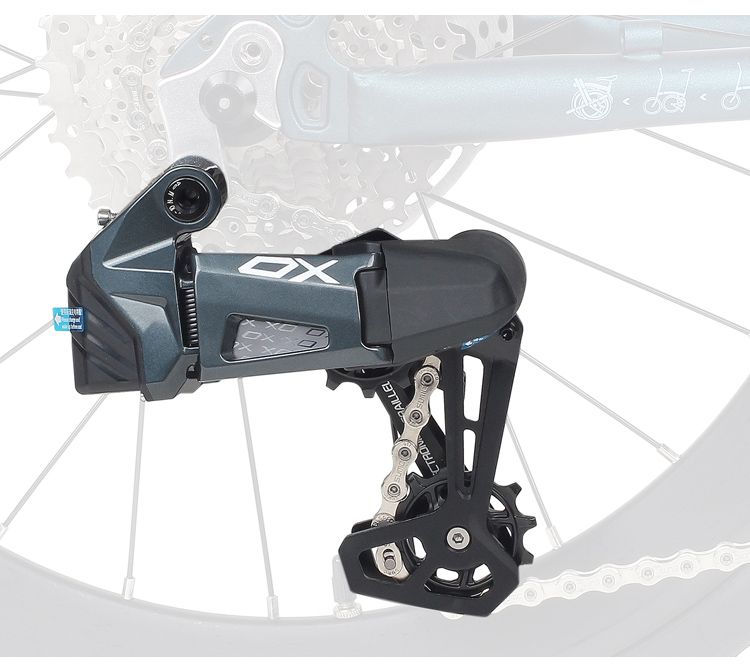
The TX is the right call for road bikes, endurance bikes, gravel bikes, and folding bikes. It's lighter, the cage doesn't hang as low (which matters on tighter clearance builds), and it's tuned for the faster, more frequent shifts you get on paved or mixed-surface riding. Worth noting: if you're building out a folding bike with electronic shifting, the TX is almost certainly what you want. We covered that scenario in detail in our guide to the best electronic groupset for folding bikes. The OX 2.0 is built for mountain terrain — trail riding, enduro, bikepacking with significant elevation, or any setup where you need that extra gear range to survive the climb. The cage is more robust, the geometry accounts for the kind of chain angle changes you get with slack MTB geometry, and it pairs naturally with 1x12 MTB drivetrains.
What They Share: The WHEELTOP Platform Advantage
Here's the thing: despite the differences, both derailleurs sit on exactly the same electronic platform. Same wireless pairing process, same magnetic charging cable, same WHEELTOP app for calibration, firmware updates, and shift mode adjustments. Otherwise, if you've already set up one WHEELTOP derailleur, the other will feel completely familiar. Shift response on both units is fast enough that it's not a limiting factor on either road or trail. Both units also support multi-shift (hold the button, run through gears quickly) and auto-trim for front derailleur setups where applicable. The learning curve is essentially flat if you're moving between them.
Price: Is There Actually a Difference?
The WHEELTOP EDS TX vs OX 2.0 difference in price is smaller than you'd expect given the different use cases. Both sit in the roughly the same price bracket depending on the retailer and whether you're buying the derailleur alone or as part of a groupset bundle. The OX 2.0 tends to run marginally higher due to the longer cage and MTB-specific construction, but the difference is small — not a meaningful decision factor. What matters more is getting the right tool for your drivetrain. Buying the cheaper option for the wrong application is false economy if your chain is skipping on the big cog three weeks later. For broader context on where WHEELTOP sits price-wise against the competition, our comparison of WHEELTOP EDS vs SRAM AXS breaks down exactly how much performance you're trading (or not trading) against a groupset that costs four times as much.
Who Should Buy Which: A Straight Answer
The WHEELTOP EDS TX vs OX 2.0 difference really does come down to one question: what kind of bike are you building? Choose the TX if your cassette tops out at 36T or 40T, you're riding road, gravel, or a folding bike, and you want a tighter, lighter derailleur profile. Choose the OX 2.0 if you're running a mountain bike, a wide-range 1x12 setup with a 42T or larger cog, or you're doing the kind of riding where chain tension management under load actually matters. Neither is universally better. They're just built for different riders. That said, if you're building a do-everything gravel rig that leans hard into MTB territory — think 650b wheels, 2.1-inch tires, 10-46T cassette — the OX 2.0 is probably the smarter call even if you're not technically riding singletrack. More capacity, more headroom, more confidence on big days. If you want to go deeper on the OX 2.0 specifically, our full WHEELTOP EDS OX 2.0 review covers real-world trail performance in detail.
Bottom Line
Both the TX and OX 2.0 are legitimately good wireless derailleurs at a price point that would have seemed impossible a few years ago. Same electronics, same app, same thoughtful charging system — just different cages for different terrain. Pick based on your cassette and your riding. It really is that simple. Ready to try it? The WHEELTOP EDS lineup ships worldwide from Aoeagle's eBay store — full warranty included.


